Showing posts with label author interview. Show all posts

Monday, November 24, 2014

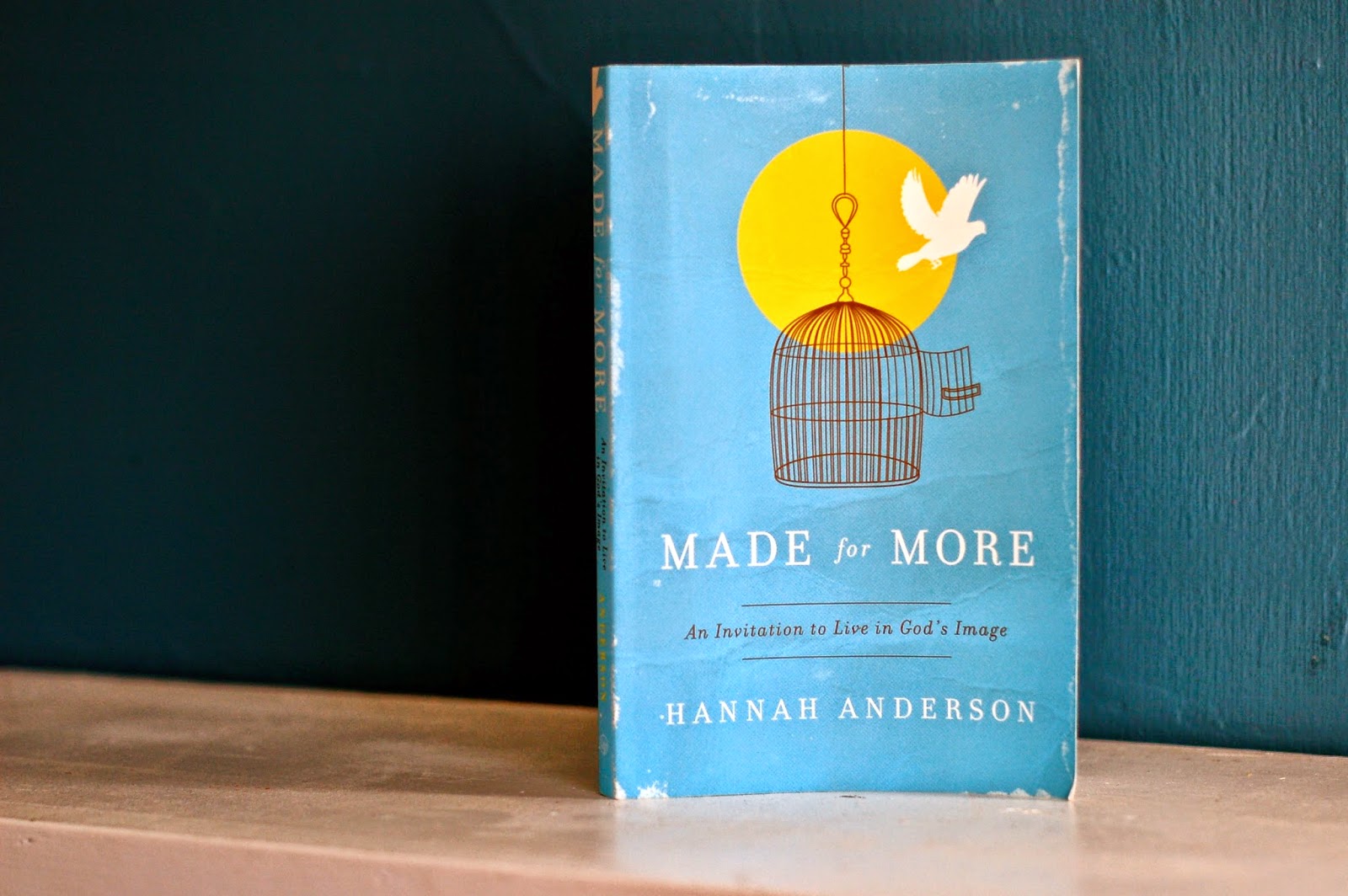
Made for More: Review and Giveaway

When I interviewed Hannah Anderson for a recent Ungrind article, I had more material than I could use there--so I am glad to use my own space today to continue discussing Hannah's ideas. PLUS, her publisher has promised one more copy of her book for me to give away here!


Let me first whet your appetite with a favorite passage from the book, one that encapsulates Hannah's thesis (and one of many that had me shouting, "Ohmygoodness YES!"):
“In recent decades, there has been strident debate about the roles of men and women in society and the church. Some argue that because gender is a significant, but not primary, part of identity, women should find their place through their gifting rather than their womanhood. Others volley back that gender should lead where a woman’s gifts are utilized and that they find fullest expression as nurturers.
But the problem with the whole conversation is that it tends to separate a woman into parts and pit them against each other. And unintentionally, women are forced to choose between two very essential truths about themselves. The fact that I am a woman demands that in some ways my identity and roles will be different from a man’s. Despite being equal image bearers, we are not the same. God even chooses to reveal aspects of His nature through my womanhood that could not be understood otherwise. So in this sense, gender itself is as much a gift—a grace—as intellect or personality could ever be.

Conversely, my imago dei identity cannot be summed up by my womanhood alone. While being a woman is essential to my identity, I am not ‘simply’ a woman. There is a part of me that transcends my gender, so in the end, regardless of how conservative we may be, we must all agree that a woman has more in common with a man than she does with a female cat!

The paradox of identity is that I am both a woman who is a person and a person who is a woman. And this will never make sense until both my womanhood and my personhood are united in Jesus Christ."
AMEN. I so love Hannah's determination to strip away all the baggage various branches of the church have brought to the "gender roles" conversation and establish a common-ground foundation: Women's primary identity as image-bearers of the eternal God, created to reflect Jesus Christ.

Chapters 8 and 9 (“Queens in Narnia: Embracing Your Destiny to Reign” and “Toward Perfect Union: Living Holistically in a Fractured World”) are worth the price of the book. I only wish chapter 9 had been written about a decade ago! How I remember the painful wrestling with my identity and calling as I was graduating from college and preparing for marriage. I absolutely loved Hannah’s metaphor of identity as a multifaceted diamond—it resonated so deeply with my journey and my struggle to reconcile opposing parts of who God has made me to be.

I still feel like there are plenty of unanswered questions as we attempt to move from vision-casting and lofty theology to concrete, practical choices--but I love how Hannah has reframed the discussion and am thrilled to promote ongoing conversation about this both online and in the local church.

With that, I'll leave you with a couple of follow-up questions and answers from Hannah:

In chapter 7, you talk about the dangers of identifying first and foremost as women, therefore making womanhood our central focus instead of Christ. You shared at Ungrind about why you think women’s ministry has so often been restricted to the “pink passages.” As a follow-up to that, how can the church “make room for feminine voices that can speak and write about doctrine and theology,” as you suggest?

HA: When I suggest that we need to make room for “feminine voices,” I’m emphasizing the truth that our experiences as men and women lend us different eyes on the same truths. For example, a woman who has gone through pregnancy and childbirth will have an entirely different insight on the process of spiritual birth than a man ever could. We must welcome these perspectives without women feeling like they have to relinquish their womanhood in order to share them. If we truly believe that God did a good thing when He made us male and female, womanhood has been given to us to reveal something about God’s nature that manhood cannot. As churches, we must find ways for both men and women to speak to the Body of Christ on doctrinal and theological issues.

At one point in the book, you acknowledge that “pursuing imago dei simplicity is anything but simple”…but then somehow “when you look to Jesus,” it will all magically fall into place. HOW, specifically, can we fight for wholeness and an imago dei focus in our own lives and in our sisters?

HA: For me, the struggle for simplicity is a process of constant re-evaluation, of learning to align my priorities with God’s priorities. When we hear the word “simple,” we often think “easy”—but that’s not the case at all. Simplicity means that the different planes of your identity are working together and you exist in God’s shalom even in the midst of busy, chaotic times.

For example, part of submitting to Christ means acknowledging my own limitations, acknowledging that HE is the Messiah, not me. So when I’m going through a period of stress, when it feels like I can’t meet all the competing demands of work and family and church, it’s really important for me to learn to let go of some things. But my ability to do this is directly related to my understanding that He is in ultimate control. I can let go because Jesus doesn’t. And when I come back to this place—when He is the center of it all—I experience His peace. Even if the dishes didn’t get done and I forgot to sign the field trip form. (Again.)

Hannah, it has been a delight to interact with you about this book and its ideas. Thanks so much for your time and for your winsome efforts to refocus women's identity around imago dei!

Grab a copy of Made for More: An Invitation to Live in God's Image at Amazon...or enter below to win! And to read more from Hannah Anderson, check out her blog, Sometimes a Light, or follow her on Twitter for frequent links to her articles around the web.

I've never run a Rafflecopter giveaway before, so we'll see how this goes...thanks in advance for your patience :) Winner will be chosen on Sunday, November 30! 

a Rafflecopter giveaway

Friday, November 14, 2014

Made for More: Author Interview

Hannah Anderson's book had me shouting YES! out loud as I read. I repeatedly scribbled "wow" and "AMEN!" in the margins. I think Made for More: An Invitation to Live in God's Image is a deeply important contribution to the church's conversation about gender roles, femininity, and identity.


I am delighted to direct you to Ungrind today, where you can find a recent interview I did with Hannah about her book--and a giveaway from her publisher! Hannah begins by saying:
When I first entered adulthood, life was pretty easy; I had my nice, neat categories. I knew who I was and where I belonged. And then life happened.
Ten years later, the roles and categories that had once given me security weren’t working anymore. I felt uncertain, out of sorts, and restless. When I looked around, I saw my friends going through very similar struggles. So I started asking myself, What have we missed? What has been absent from the conversation that would explain why so many of us are longing for “more”? It turns out that the “more” we needed wasn’t more opportunity or different roles; the “more” we needed was God Himself.
 Head over to Ungrind for more, plus a chance to win one of two copies of the book.

...And stay tuned, because I'll be revisiting this next week with more of my thoughts about the book and some "bonus material" from my interview with the author!

Friday, June 10, 2011

Author Interview: Lisa Velthouse, Part 2

Today's post is continued from yesterday's interview with Lisa Velthouse, author of a new memoir called Craving Grace (which I reviewed here).

AK: Have you had moments of regret in terms of how honest you were about various events and thoughts? How have you dealt with the vulnerability brought on by the book's publication?

LV: I’m not sure I would call it regret, but yeah. Brutal honesty does bring about a certain sense of increased vulnerability. I can be a people-pleaser, so I have a hard time in particular thinking that some of what I wrote might unintentionally shed negative light on some people, groups, and things. Concealing character identities helps with that fear—you mask somebody so that nobody knows who you’re talking about—but there’s only so much a writer can do.

For instance, Amy, in your earlier review you note that Craving Grace is a bit harsh about Saving My First Kiss (that’s a terrible summary of your review, but you get the idea). You’re right; it is a bit harsh, probably unfairly so. Part of the deal with this memoir, though, is that I didn’t want to caveat my behavior for caveat’s sake. The reader gets a true picture of who I am and who I’ve been, which often includes unfair reactions and levels of emotion. Hopefully we can all learn from the ugliness of it. For instance, I’m not nearly so harsh about my first book now. :)

AK: I would imagine memoir writing gets sticky when you begin to tell other people's stories as part of your own. How have the friends and family members portrayed in the book reacted to your stories about them?

LV: This relates so well to the question above. I learned early on in writing that it should be a careful matter, telling other people’s stories. In the past, I’ve written about another person, thinking that the story is wonderful and portrays them in a wonderful way, only to find that they felt differently and were offended by something. Now I try to give people a heads-up early on and then an advance read that includes veto rights. With Craving Grace, the reactions I got were pretty fun. Several family members and one of the Coras reacted with, “I had no idea!” Revelations everywhere. :)

Along with this, one of the crazy writing lessons in Craving Grace for me was that books, when compared to real life, have a miniscule capacity for characters. Many of the people who are big parts in my life—some family members and friends in particular—don’t have a place in the book. They simply weren’t big parts of certain events and conflicts, so they didn’t make it into the story. I wish I could’ve managed to honor everybody by working them in, but it would’ve become a free-for-all that way. Thank goodness for the Acknowledgements.

AK: A significant element of the book is your experience of grace through living in community with other believers. How will you look for that kind of community in new places after having experienced its rich sweetness in Michigan?

LV: The Apostle Paul writes that we are to “bear one another’s burdens.” Implicit in this is the idea that Christians should, rather than carrying burdens on their own, make their burdens known. I’ve been thinking about that a lot lately. The burdens I tell of in Craving Grace are of the sort that most Christians consider obvious and urgent: I was in debt, I was lonely, I was sad, I was confused about God, I needed a place to live. These are the sorts of things that Christians are good at helping with: a little cash, a little friendship, some answers, some encouragement, a spare room in the basement. I experienced new depths of faith when others provided for me, eased my burdens, and let me be part of their lives.

But circumstances have changed for me, and now my burdens are the less-obvious sort. Still-newly married and newly moved across the country, I crave deep friendships here. I need advice on how to be a better wife. I’m worried about my military husband’s ever-looming next deployment. I need to figure out how to weed the backyard. We could really use help getting rid of the boxes in our garage. Why don’t I think to say these things? Why do I assume they’re not burdens, that they should be borne by only me?

The other side to that is: Two weeks ago, my husband and I are now living in our first house. We were able (because of a terrible market) to buy a place that’s a little bigger than only we need, so a family member of ours is living with us too. It’s a great arrangement; it helps us pay the mortgage, offers him cheap rent, and gives us all a better sense of community and reliance. But it’s harder on him than it is on us, because this is our house. Without us, he wouldn’t be living here, but without him, we still would. So he’s more likely to feel like an inconvenience. More likely to apologize for being a burden. And it’s so easy for me to forget that I’ve been in that place myself, to forget how awful and consuming it can be. So I’m learning, I hope, how to give with graciousness and how to bear others’ burdens better.

AK: Can you now answer Cora's question on page 59: How has your life changed as God has become the sweetness in it?

LV: Certainly I can’t answer it fully, but I can give it a shot now, and that’s progress. I’ve begun to understand the depth of my own sin—it is sinfulness, the reality that even my nature is an offense against God. But with this, God’s grace has become real in my life of faith, because now it’s not merely Bible verses, memorized and mostly forgotten. It’s real, both in need and provision. There is such joy in that, and such worship. I used to follow God because I knew it was what I should do. Now, hopefully more each day, I follow him because I like being with him. He is love to me, and justice and hope and truth, even when I don’t understand what he’s up to. That makes it a pleasure to follow and obey.

Thanks so much for taking the time to answer my questions, Lisa! I so enjoyed "talking" with you a bit more about your book and your life.

Find Craving Grace on Amazon and be sure to check out Lisa's blog as well!

Thursday, June 09, 2011

Author Interview: Lisa Velthouse

Today I get to bring you a first-time treat: an author interview! Lisa Velthouse, whose lovely memoir I reviewed a couple of weeks ago, agreed to answer some questions for me and my readers. I loved reading through these behind-the-scenes thoughts that provide a complement to Lisa's book Craving Grace. (And if you're visiting from Lisa's blog: Welcome! I hope you'll poke around a bit and maybe even come back :)

Because I gave her a lot of questions and because she answered thoroughly and thoughtfully, I think there's too much material for one blog post--so I'll post the first half today and part 2 tomorrow.


AK: On page 97 you speak of your book going in a different direction than you anticipated: “The irony is not lost on me, not one bit, that while writing a book about God's grace I will every day be trying to cope with a houseful of generosities I don't deserve. ...So it will have to be both past and present, Grace and grace. It will have to be terrible and captivating like it was the first time.” (I love that last line!) How is this book different from the book you initially proposed to your publisher? (What did you originally think Craving Grace was going to be?)

LV: My earliest and midway-through drafts focused entirely on my discovery of grace (or, probably better, its discovery of me): that grace, not works, is the only catalyst for a life of faith. In those drafts and outlines, grace was the big prize at the end of the last chapter, a payoff to thorough readers. But it didn’t work. The story was stale somehow, incomplete. I was writing three years after those first grace experiences, and I knew from life that grace is more than just the spark that starts me off toward faith; after the spark, it becomes the fuel that keeps faith burning.

So I ended up weaving two timelines together. The first timeline is past tense: looking back on my fast from sweets, during which I first learned to accept grace. The second is present tense, writing the book and living in community and still craving grace. My hope is that it gives a more full picture of how grace both starts and keeps working in a person’s faith.

AK: It seems unusual to write so consciously about the process of writing—in what ways did that make the writing uniquely challenging? How did you discover more of God's sweetness through the process of writing a book about it?

LV: Oh man. Great question. It’s funny, because when I think of it, I think of it as writing not about writing but about writer’s block. :) From start to finish, I struggled to complete this manuscript. As a person who tends to find value in her accomplishments, that struggle isn’t the sort of thing I prefer for people to see. So those parts of the story are one more example of God whittling away at my pride and my knee-jerk mentality, which is, “I can manage all this perfectly, thank you.”

Everyday failure is a tangible reminder of my need for God’s grace: here’s yet another instance where I on my own am not enough to get by. For me, those failures—writing is just one; Craving Grace tells of many more—have become a consistent reminder of what is true about me. On the whole, my life is sinful and broken and apart from God. But in Christ, I can have righteousness and restoration and unity with God. That comes only through grace, which is free to me and of total cost to Him. It’s powerfully sweet in every instance. That goes for the macro, which is my need for ultimate redemption, and the micro, which sometimes is just sitting at a computer needing to finish this sentence.

AK: Tell us more about Cora. I would expect you to change some characters' identifying details—but I was intrigued (and confused) right from the “Author's Note” page about the creation of a composite character. Was this because your conversations and experiences with Cora were actually experiences with several different mentor-like women in your life? Is creating a character like this a common practice in memoir writing?

Composite characters are common and accepted in memoir writing. I’ve been privileged to have many strong mentors in my life; Craving Grace tells of one, Cora, who is in real life actually two. I made Cora a composite because of technical and relational reasons: there are only so many characters that one book can handle (far fewer than I had suspected), and both the true Coras are so humble that neither would be comfortable carrying the weight of the whole character. (Though either on her own could have.)

The true Coras also happen to be demographically different, so I picked a few demographic details from each and then meshed them together. This accomplished two important goals: it simplified the story, allowing that readers wouldn’t have to keep track of two mentors, and it provided the real Coras with the privacy I knew they would appreciate. Now only I and they know which stories belong to each of them. Still, I assure you that Cora is even more incredible as two real-life people than she is as the book’s one.

AK: Over the last several years you've had quite a platform for speaking to young girls, in large part related to your first book, Saving My First Kiss. How has your message changed since experiencing the events of Craving Grace and then having the book published?

LV: That has been an interesting progression for me. I’ve been speaking to young girls about sexual purity since I was 18. In those speaking opportunities, I was always careful to emphasize grace—became I knew God forgives—and I always shared about my personal vow, which was to save my first kiss until I was engaged. In terms of sexual purity, for a long time that was the only personal story I could share—as Craving Grace tells, it wasn’t until I was in my mid-twenties that I got asked out on my first date. Well. Also as Craving Grace tells, I wasn’t so successful at keeping my one big vow. And I’m older, so I can better understand that complicated things are complicated.

Anyway. The issue of purity isn’t so simple to me as it was before. I can relate more to the struggle, because I’ve been through it more now and because now the issue of grace is no longer separate from the issue of my vows. I know now that vows should be made to God because of his grace, out of gratitude for what he has done. And I understand now that every human vow of obedience is in one sense flawed, because it’s human. I kissed a guy I wasn’t engaged to. Kissed him twice! That was a huge failure for me, because it was breaking my vow to God. It hints my propensity to disobey, my pleasure in disobedience. But in Christ it is possible to obey God. A few years after those first kisses—here’s something you won’t find in Craving Grace—my husband and I were both virgins when we married, and that has been great for our marriage and our faith probably in more ways than we realize. In terms of speaking about sexual purity, I still value the same principles I valued before, and it’s still the same message, but far more faceted now.

[Come back tomorrow for part 2 of my interview with Lisa!]