Showing posts with label Christianity. Show all posts

Wednesday, October 04, 2017

Hanging and Hoping

photo: Flickr/Jared Tarbell
When I was in elementary school, gym class at some point during the year included an activity I quickly grew to loathe: the rope climb. In the makeshift office area (it had once been a stage) off the gymnasium, a long, thick rope hung from the ceiling. Our class would line up in a row, and one by one, each kid had to step forward and shimmy as far up the rope as she could.

As a skinny kid with noodle arms, I didn’t have near the upper body strength to reach the top. In fact, I could hoist myself exactly zero inches up from my highest reach when dangling at the bottom. It was humiliating to hang there, the rough strands of rope burning my hands, unable to pull myself up.

I spent a good portion of my pregnancy meditating on 1 Peter 1, and at some point in the midst of memorizing, I remembered that old rope. I read “set your hope fully on the grace that will be brought to you at the revelation of Jesus Christ” and pondered Jen Wilkin’s exhortation at TGCW16 to set your hope *fully* on God, not partially. I pictured not just the one rope but two giant ropes hanging from an impossible height. In my mind’s eye, the ropes don’t merely hang a couple of feet off the ground, with a kid-sized chair at the bottom; below them is a black hole of darkness.

I picture myself suspended between those two ropes. This time my assignment isn’t to claw my way to the top; all I have to do is hold on, keep from falling into the darkness. I’ve got a death grip on each one, but I’m dangling in the middle, vulnerable, precarious. My strength can’t hold out forever. The ropes burn my hands. My fingers cramp and my shoulders ache; the muscles in my arms start to quiver. This is what it is for me to hope partially (even *mostly*) in the grace of Christ and yet also not be willing to let go of other hopes.

What I can't feel or see is that one of the ropes is slowly fraying at the top--fiber after fiber breaking under the strain of my weight. It won't hold forever. If I will let go of that other rope and devote all my strength to the sure and solid one--the one anchored in the Rock that is my Savior--I can wrap my entire body around it. I can grip it with both hands, forearms pulled securely against it. I can hold it right next to my whole body, twist my legs around it, even use my feet for extra traction. If one hand gets tired, I can let go and shake it out while the rest of me holds tight. And if I grow weary and start to slip, I will not freefall into the chasm below the ropes—I will simply slide down this one rope a bit. Even if my strength should fail and I slide all the way down—there is a steadfast knot tied at the bottom, massive, firm enough to stand on. In the end, it will hold me.

Thursday, June 30, 2016

The Pursuit of a Person

If I set out to become a better mother, the internet would have no shortage of advice for me. I wouldn't have to look far to come up with an exhausting list: things to stop doing, things to start doing, things to do differently; what to think, what to say, what not to say, how to connect, how to discipline, when to teach, where to teach--you get the picture.

But my role as a mother is not an abstract job title. The fact that I can be called a mother at all is a function of relationship. My approach to motherhood cannot be an impersonal strategy; it is intimately connected to two living, breathing people.

So while strangers on the internet, or expert authors, or even trusted friends and family, can give me helpful insights and wise counsel...the single most important priority in the pursuit of "becoming a better mom" is the pursuit of Elijah and Jude. To grow in motherhood means to move toward my sons. It happens as I spend time with them, listen to them, observe them. It happens through intentional efforts to know them better, through building shared memories and learning how to meet their needs. I become a better mom only so far as I deepen my relationship with my sons, only so far as I love Elijah and love Jude.

*     *     *

Sometimes in our efforts to avoid legalism, we drive into the other ditch, believing that any earnest effort to obey God smacks of self-righteous attempting to earn God's favor. Hebrews 12:14 corrects us:

"Strive for peace with everyone, and for the holiness without which no one will see the Lord."

To strive is to run hard, to chase after, to pursue. "Run swiftly in order to catch...holiness!" And the command is accompanied by a warning: "...without which no one will see the Lord." These are sobering words. The pursuit of holiness is not optional; it is essential to the life of faith. It is not the means by which we are accepted by God, but it offers evidence that we belong to Him.

But I think the core of this call to pursue holiness is best understood as a call to pursue a Person. The way to avoid self-righteous legalism is not to avoid the striving. It is to clarify what--or rather, WHOM--we are chasing.

We would have no reference point for "holiness" apart from God. He is True North; He *is* holiness. "Holy, holy, holy is the Lord God Almighty." Holiness comes from Him and is defined by Him. Our call to holiness is always rooted in His holiness: "You shall be holy, for I am holy." 

Holiness is not a set of attitudes or behaviors, an abstract state of being. It is the essence of His character; it does not exist detached from Him. So to pursue holiness is to pursue Him. Strive to know Jesus. Draw near to Him. It's not about a list of qualities you attain to or exhibit; it's about a Person you love and resemble. 

Take, for example, the practice of reading/studying/meditating on God's Word. All Christians know they are "supposed to" do this. But WHY? Do we read the Bible as part of a checklist of "good Christian behaviors," something we do to accrue points? Does time in Scripture give you a higher "Holiness Score"?

No--we go to the Word to see Jesus. To know Him. This is where He is most clearly revealed, where He speaks to us. We read and study and meditate as a way to pursue Christ--a way to see His glory, to understand His heart. With this foundation, holiness is not about us. It's about looking like Him. We admire our Elder Brother, and we imitate what we see. We become what we behold.

By all means, pursue holiness. But don't merely strive for an abstract state of being. Chase after a Person--not just any person; our Redeemer and Savior! Our ultimate goal is to be near to Jesus because without HIS holiness, we have no hope of seeing the Lord. It is His perfect record of righteousness that makes us fit to enter the King's presence. Without holiness, no one will see the Lord. But because Jesus' blood makes us holy, we have the privilege of striving, pursuing, running hard after Him--desiring to be near Him and so becoming more like Him.   

Monday, February 22, 2016

Wallow or Fight

In every trial, large or small--whether a one-time instance of being sinned against, or an especially difficult season of life with no end in sight--there comes a crucial moment. Actually, it doesn't come just once, but dozens of times. It is the moment when you recognize you might actually not be sinless in this mess: when you realize at some deep level of your heart, in some small part of your mind, that there is a significant difference between what God says is true and what you are thinking or feeling. It's the moment when you see that the problem is not only others' sin or out-of-control circumstances, but also your own unbelief.

In that moment, you are faced with a choice. You can continue to rehearse the laments ("vent")--to your journal, your husband, your best friend, or just on an endless internal loop. You can dwell on the potential miseries, feed the fears and the resentment, preach to yourself about how much you suck or how wrong the other person is or how awful this is going to be.

Or you can fight. You can let go of your plans, surrender your emotions, settle into what IS rather than what you wish life were. You can't fight a week-long or a six-month or a ten-year battle, but you can put on your armor and fight for joy--fight to believe truth--today.

When I come to this critical realization, there's a little part of me that doesn't want to give up the wallowing yet. Sometimes I just want to keep stewing in a big ol' pity party for a while. More than that, I think I fear that choosing to fight means pretending that these emotions weren't real and deep, that it doesn't really hurt. But...I can acknowledge them as powerful and real without being ruled by them. And reality is, wallowing doesn't accomplish anything. It doesn't change the situation, and it doesn't make facing the trial any easier. In fact, you could argue, just the opposite.

Fighting, on the other hand--that changes everything. It means you will get beat up, even face the agony of defeat at times (though this is made bearable knowing you will never face ultimate defeat because victory has already been won by Christ!). It doesn't mean being Pollyanna, slapping on your shiny, happy Christian face and pretending. It means gritting your teeth and digging in your heels and clinging to Jesus with all your might. It means repenting; it means crying out "I believe, Lord--help my unbelief!" It means preaching to yourself about how God sees and loves you in your unlovable mess, how Jesus' blood covers all the ways you suck, how all this is going to be a *beautiful* mess because it's going to be used for your good and God's glory. Guaranteed.

For me, it means being vulnerable and humble with my husband and other trusted friends, asking them to fight for me, relying on them to hold up my trembling arms as Aaron and Hur did for weary Moses, to hold up their shields of faith when I cannot keep mine upright. It means, to paraphrase Tim Keller, trusting that although these events may reveal me to be more sinful than I even believed, I am also, in the midst of them, more loved than I have dared to hope.

I am not called to fight the hundred-years' war. I have only to fight in this moment. I cannot look ahead and fear what may come; instead, I must fix my eyes on Jesus, be fully present HERE, and trust that the grace for tomorrow will be there tomorrow.


Related:
Acceptance = Peace
Divine Love Put Me Here
Joy. Here.
Besieged


[edited repost from the archives]

Thursday, November 19, 2015

Naples Day 5: Cappella Sansevero - Veiled Christ

Almost any guidebook or website will tell you that one of the top five must-see attractions in Naples is Cappella Sansevero, the home of Giuseppe Sanmartino’s sculpture Cristo velato (Veiled Christ). After lunch, we walked a few blocks to take in the sight. (Photography was forbidden inside, and I was only able to find a couple of photos online licensed for reuse--but you can see more at the website linked above.)


The chapel was built in the late 1500s as a mausoleum, but was decorated in baroque style in the mid-1700s by Prince Raimondo di Sangro, who commissioned the art for the chapel. It houses a few other impressive pieces, including Queirolo’s Disinganno and some way-ahead-of-their-time anatomical models, but the highlight is without a doubt the sculpture showcased in the center of the chapel.

Veiled Christ is breathtaking. The way the veil seems tissue-thin…again, the skill and artistry left me dumbfounded.


But beyond thinking about the sculpture as art, it was also moving spiritually/theologically. I was especially struck by seeing it on the same day as the archaeological museum’s Greek and Roman statues. In the morning, we saw pagan gods portrayed as strong, beautiful, larger than life. Then in the afternoon we saw the Christian God: vulnerable, wounded. Dead. The juxtaposition was powerful. Is it any wonder the first Christians were seen as lunatics for worshiping a God who could be defeated like this?

It was incredible to look at the folds of the veil over visible nail holes in the feet and think about how our God suffered and perished—for us. His body was bruised and broken; He let Himself be crushed for us. He really did lie in a cold tomb under a veil. But oh, that was not the end of the story! Because He was crucified and died for us, and then rose again to new life, He alone is worthy of worship. His willingness to be vulnerable and take on our flesh made Him able to save to the uttermost in a way that those Greek and Roman "gods" never could.
"Surely he has borne our griefs
     and carried our sorrows;
yet we esteemed him stricken,
     smitten by God, and afflicted.
But he was pierced for our transgressions;
     he was crushed for our iniquities;
upon him was the chastisement that brought us peace,
     and with his wounds we are healed"
(Isaiah 53:4-5).

Wednesday, November 18, 2015

More Reading on the Refugee Crisis

The Italy series is still on hold for now because I have been spending my writing time reading and learning instead. A few more refugee-related links:

Not Afraid - Hannah Anderson
[I want to quote the whole thing on this one--it is SO GOOD.]
I understand that we cannot solve every geo-political crisis. I understand that we may not choose to involve ourselves in a ground war in Syria. I understand moral proximity and the order of loves. I understand that refugees must undergo strict a process to enter this country, whether they are Syrian or not.

But what I cannot understand is how easily we can turn a deaf ear to the wounded man lying on the road to Jerusalem just because of ethnicity. 
I cannot understand how quickly we’ll cross to the other side. I cannot understand how, like the young lawyer, we can justify our lack of compassion by asking “Who is my neighbor?”

Your neighbor is anyone who God brings into your life–Muslim, Christian, Syrian, French, or Iraqi. When someone is lying bruised and beaten beside the road and you’re taking that same road, he is your neighbor. Run to him. When someone knocks on your door legitimately seeking sanctuary, open it. And if we don’t, don’t be surprised if that same God doesn’t come down in judgment because we’ve failed to reflect his own hospitality. We may fear the possibility of a terrorist slipping through the cracks, but Jesus reminds us that we’d do better to fear Him who can throw both body and soul into hell.
 
Being pro-life is not about holding onto our rights, protecting ourselves, or insisting that a choice is legitimate simply because it is legal.  This is the rhetoric of the pro-choice movement: Protect yourself first. Don’t risk your sense of security to provide a safe place for another human being.
Instead, being pro-life means having the faith to believe that the God who calls us to do difficult things is big enough to care for us in the midst of them. Being pro-life means being people of courage and self-sacrifice. Being pro-life means being people of hospitality.

Six Reasons to Welcome Refugees After Paris: America Must Demonstrate Moral Courage (Foundation for Economic Education)
After the attacks on Paris, many politicians — including (so far) the governors of Alabama, Arkansas, Louisiana, Michigan, and Texas — have called for stopping refugee flows to the United States from the Middle East, claiming that the refugee process poses a major threat to America’s security. Here are six reasons why ending US refugee resettlement is a mistaken and reactionary approach.

Something Christian Millennials Don't "Get" (Life in Progress Ministries)
[The headline is terrible--clickbait-y and misleading, irrelevant to the content--but the content itself is provocative.]
I find myself today witnessing some Christians who seem to want to be as not like Jim Elliot as possible. I do not understand this. ...For years and years and years it has been nearly impossible to get missionaries (even sneakily) into parts of the Middle East. It’s so dangerous, some, assuming they can even get in, are likely to be killed so quickly they can’t do much evangelizing. And now, hundreds of thousands of beaten, hurting, orphaned, widowed (google “pure and undefiled religion") and broken people are trying to come to US. Is it possible that a small percentage of them want to kill us? — Let me counter that question with another question: Does it matter?
...Open up a Bible and make a convincing argument that Jesus wants us all to be safe more than he wants us to reach the lost and help the hurting.

Responding to the Mounting Refugee Crisis
Responding to the Mounting Refugee Crisis (BONUS FEATURES) from FAI on Vimeo.


The Refugee Crisis and Christian Hope - Reformation21
[This one is heavy and hard to get through, but pointedly explores some of the challenges that come through accepting refugees. The author strongly warns against sentimentality and distinguishes
 between what the state can and ought to do and what Christians can and ought to do.]
We should be under no illusion: in the name of blinkered compassion we are at incredible risk of creating an angry and powerful underclass that is resolutely hostile to Europe and its values, and a popular swing to the far-right in reaction against it. Many of these refugees seem to recognize Europe's guilt-driven 'charity' for the cultural emasculation that it is and, rather than showing gratitude for their welcome into other people's places, manifest an attitude of angry entitlement to and hostility towards Europe's places, people, customs, and societies. While this is by no means universal, it is widespread enough to justify genuine concern.

...Few moral issues facing us in our day require such careful navigation between treacherous hidden shoals of false virtues and well-intentioned folly as that of the mass movement of refugees. Fulfilling our calling to be both wise as serpents and harmless as doves is an immense, yet never more pressing, challenge.

Tuesday, November 17, 2015

Thinking and Praying About the Syrian Refugee Crisis

I was going to put a post up today about how crossing the street in Italy caused me to fear for my life.

That feels so inappropriate in light of all I've read today about the Syrian refugees who have far more dramatic and significant cause to be terrified for their lives, however startling Italian traffic may have been.

Instead, for tonight, I think I want to share a few of the links I've read today. I understand this is an incredibly complex issue that cannot be easily solved, certainly not in a 140-character tweet (though this man admirably tried, and I have to say I snort-laughed over his attempt...it was either that or cry):


In all seriousness, though--I do realize that there's far more nuance than can be communicated in a Facebook status or a 500-word article. What a Christian/church should do is not necessarily the same as what a government should do. I don't know all the answers. But what I do know is that some of what I have been reading has the aroma of Christ...and some of it just does not. At all. I grieve over the posts I have seen with a whole lot of “we’ve gotta look out for number one” and “they/them/those people,” but very little Scripture or empathy or compassion…a whole lot of fear and worry and self-protection, but very little love or courage. 

It’s not a simple argument. Still, I think at minimum, any Christian who is vehemently shouting “CLOSE THE BORDERS!” needs to take a long, hard look at Matthew 25 and the dozens of other Scriptures like it that call us to welcome the stranger, to love, to lay our lives down, to not be afraid. I'm really not sure what we do with those verses, however uncomfortable they may make us...


Should We Really Close the Border to Refugees? Here's Why Fear Drives Out Compassion - Trevin Wax
Fear leads to hatred; courage leads to convictional compassion. And convictional compassion means differentiating between the radical Islamists who would destroy us and peaceful Muslim neighbors who stand with us in deploring such violence.

We are in a war. An unconventional war, of course, but a war nonetheless. Wars always bring out the best and worst in humanity. When future generations look back in time, let us hope they will see that we met these challenges with courage, not fear. In doing so, we obey the most frequent command in the Bible, “Do not be afraid.”

Questions Regarding Waves of Terror and Walking on Water - Shawn Smucker
Protecting ourselves, protecting our best interests, that’s the logical thing to do. Even if it means turning away people with legitimate needs. But it’s not the Christian thing to do.

...It’s actually rather upside-down, rather silly. But that’s the Kingdom of God for you, because the Kingdom of God doesn’t make sense. In the Kingdom of God, we do good for those who hate us. In the Kingdom of God, the smallest of things can move mountains. In the Kingdom of God, we are told to return violence with non-violence. The first will be last, the last first. The meek will inherit the earth. It’s a Kingdom that belongs to the poor in spirit. It’s a Kingdom that doesn’t make any sense.

What does make sense? Well, it would make perfect sense to stop welcoming refugees – after all, they might be ISIS! It would make perfect sense to stop taking in the needy, the orphans, the widows – after all, they might simply become freeloaders! It would make perfect sense to turn our back on those we consider enemy, those we consider other, those we don’t understand. ...It would make perfect sense to turn inward. But it doesn’t make Kingdom sense.


Jen Hatmaker on Facebook:
Let me tell you something, Jesus: LOW BLOW. I do NOT want to see your face in the faces of these complicated, hurting, needy people. When I see a prisoner, I want to see "criminal." When I see the homeless, I want to see "addict." When I see a refugee, I want to see "threat" or at least "financial drain." What I do not want to see is your sweet face.

Why couldn't you identify with more stable people? We like you in the faces of our children and best friends, for example. We like you in our government and in our Family Friendly Movies. We like you in our pretty churches and gated neighborhoods. We do not want to see you in the faces of the poor. That sucks. Now you are really messing with us. You do realize what this sort of holy identification will cost and require, right?


Suspicious of Syrian Refugees Coming to the U.S.? Here's a Reality Check - Janell Ross

Refugees are subject to more scrutiny and background checks that any other group admitted to the United States.  ...simple changes to the order of certain steps in process would leave a robust clearance program in place but eliminate unnecessary redundancies, red tape and difficulties.
What we do know is that extended waits can contribute to the number of people desperate enough to undertake a highly dangerous journey and enter a third country illegally. People in refugee camps cannot legally work. In some camps child mortality rates are alarmingly high and people live in tents. Many others are housed in buildings without heat or running water.
...While...7 in 10 refugees making their way across the Mediterranean are adult men, the overall refugee picture is much more balanced. (The adult-male skew above makes more sense when you consider the danger involved in the journey.) Among the 4.05 million Syrians who have fled their country and then registered with UNHCR (the United Nation's refugee agency), there are actually slightly more women than men. 

No, Thousands of Syrian Refugees Are Not Arriving in New Orleans - Aaron Earls
...do you care about the truth and do you want to undermine your credibility and reputation so conspiracy theorist bloggers can make more money on pop-up ad revenue? ...You cannot lament the dishonesty of mainstream media outlets while promoting and sharing stories from conservative blogs that do nothing but exaggerate, mislead and blatantly lie to push their agenda.

The Islamic State Wants You to Hate Refugees - Adam Taylor
What seems almost certain is that the Islamic State wants you to equate refugees with terrorists. In turn, it wants refugees to equate the West with prejudice against Muslims and foreigners.

Immigration Policy Must Be Based On More Than an Appeal to Compassion - Kevin DeYoung
[much helpful balance and nuance here, which I am able to hear and consider when it is prefaced with "I too am turned off by the harsh anti-immigrant rhetoric that sounds more like Pharaoh in Exodus 1 than the “love the sojourner” commands in Deuteronomy 10. It is a commendable response to see hurting people and think, 'Let’s do all we can to help.'" YES. Thank you.]

...The issue of immigration—both for those inside the country already and for those wanting to get in—is bound to be a pressing political, international, and humanitarian concern for many years. We need Christian writers, thinkers, pastors, scholars, and activists to be a part of the conversation. My plea is that the conversation reflect the complexity of the situation and goes beyond the familiar dichotomies of love versus hate, inclusion versus exclusion, and fear versus compassion. There are too many important things, and too many human lives, at stake to move quite so quickly from solid Christian principles to simple policy prescriptions.

Wednesday, October 21, 2015

Learning to Enjoy the Beauty

My default mode is to look for error. I have been a perfectionist my whole life, and so my sharp eyes examine carefully to spot flaws. I easily see what’s wrong, what’s ugly, what doesn’t work. This mistake-radar serves me well as an editor and writer; it’s less helpful as a mom, a wife, a friend.

Over the years, I’ve been reminded again and again of the need to take a second look. I must learn to see — my own life, others around me, the world at large — through a lens focused on grace. If I am skilled at finding fault, I want to become even more adept at finding beauty. This world is full of ugliness, to be sure, but it is also full of people made in God’s image, full of His handiwork, full of His gifts.

My newest article at Ungrind is about how and why I'm learning to see and celebrate the beauty in people--check it out!

Monday, April 27, 2015

Needing to Be Needy and Fighting Together

Breastplate of righteousness. Belt of truth. Helmet of salvation. Shield of faith. If you’ve been in the church a while, you’ve heard more than one call to “suit up” with Ephesians 6 armor. And if you’re like me, you’ve imagined yourself as a solitary soldier, dressed head to toe and ready for spiritual battle.

It wasn’t until much later that the obvious dawned on me: A lone soldier is a sitting duck. 

Last month at Ungrind, I wrote about our need to be honest about our physical needs and the glorious glimpses of grace seen in helping and being helped. Today, I'm over there discussing spiritual battles--because if it’s hard to ask for help with practical needs, it feels downright impossible to reach out for support when we’re emotionally or spiritually low. We’re embarrassed that we’re still struggling with the same old sin; we’re frustrated by how stuck we feel, maybe even too cynical to believe a friend’s words could make any difference. Yet we need each other even more here, in our most tender places of vulnerability.

Click over to read about how I'm experiencing grace when I'm needy and grace to help others fight

Thursday, April 16, 2015

After Easter

"Why do you seek the living among the dead? He is not here, but has risen. Remember how he told you, while he was still in Galilee, that the Son of Man must be delivered into the hands of sinful men and be crucified and on the third day rise." (Luke 24:5-7)

Over and over Jesus had told them of His coming death, and they stiff-armed the prophecies. "No, Lord!" We won't accept this. Not what we had in mind. Makes no sense. It cannot, must not happen like that.

If you cannot or will not hear the bad news, you cannot, will not comprehend the good news.

If you do not embrace the painful, the ugly, that which is terrible and does not make sense--you will not be prepared for the weight of glory.

Without the death, there can be no resurrection.

With dull and disbelieving hearts reluctant to accept His statements about His death, they primed themselves for confusion and doubt about His resurrection. "They were perplexed about this" (Luke 24:4).

And yet. This resurrected Lord is the One who opens blind eyes. He does not leave them alone in their confusion; He sends His angels to proclaim holy truth, remind them of what they failed to believe. "Remember how he told you."

Still they did not believe.

So He came Himself. "Jesus himself drew near and went with them" (v. 15).

I'll wait while you go back and reread those words. Let them stun you: Jesus himself drew near and went with them.

"He went in to stay with them" (v. 29). He sat down with them. He ate with them. "He took the bread and blessed it and broke it--" This is My body, given for you.

"And their eyes were opened."

This patient, patient Jesus. The Lord has risen indeed.  

Friday, March 27, 2015

The Beauty of Serving and Being Served

In recent weeks, as friends of mine have faced various trials, I’ve had occasion to marvel at the beauty of women asking for, giving, and receiving help.

And I've not always been on the giving end; my servant-hearted husband frequently gives me food for thought and reasons to be thankful as I receive gracious help from him. 

We hate to feel needy; we don’t want to burden others. But when we are ashamed of our weakness, or too proud to admit our need, we commit robbery.

Click over to read my article at Ungrind today about the glimpses of glory that can be seen when we cast off our pride, admit our weakness, and ask for help.

Wednesday, December 17, 2014

Parent Tantrums and Merciful Love


Six-thirty a.m. on a school day. No amount of sugar-coating will make it less ugly, so I'll just be frank: I threw a colossal temper tantrum. Complete with name-calling and kicking a kitchen cabinet. I yelled. I slammed dishes around. I shamed and belittled a seven-year-old. Just seeing this description of myself in black and white makes me want to crawl in a hole...but there it is.

By the time we needed to leave, I wasn’t yet truly feeling sorry. I hate to admit it, but I didn’t have a sincere desire to repent and reconcile with my kids. I was still angry—a combination of anger over the original trigger, and anger at myself for acting so irrational and out-of-control. Mercifully, I had a moment of clarity, realizing that if something happened that day, and the last interaction I had with my son was this shameful tantrum, I’d never be able to live with myself.

So I knelt down and looked in his eyes. I told him that although I had been angry, that didn’t make it OK for me to yell at him and call him a baby, and I was wrong to treat him like that. I apologized and asked him to forgive me.

Elijah didn’t hesitate to extend forgiveness. It frequently blows me away how quick my children are to accept my apologies, even when I’ve been horrible to them. I hugged and kissed him, and also hugged and kissed my four-year-old (who had suffered collateral damage from my tantrum, receiving a few harsh words of his own for minor things that ordinarily wouldn’t have been such a big deal), and we got in the car.

While the instant forgiveness was beautiful and impressive, that wasn’t what struck me hardest. The really remarkable thing happened later that morning.

[Head over to Ungrind to read the rest!]

Monday, November 24, 2014

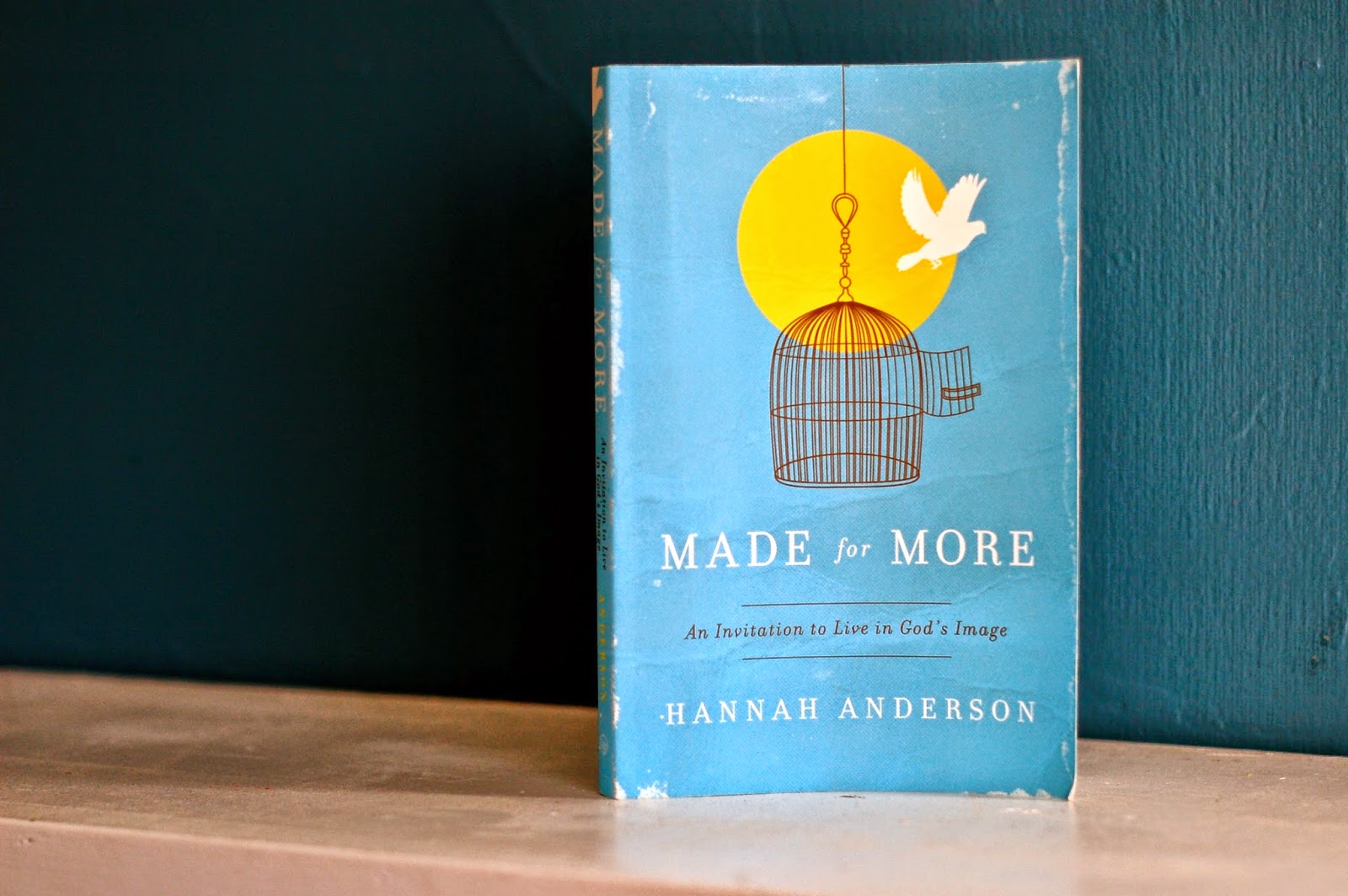
Made for More: Review and Giveaway

When I interviewed Hannah Anderson for a recent Ungrind article, I had more material than I could use there--so I am glad to use my own space today to continue discussing Hannah's ideas. PLUS, her publisher has promised one more copy of her book for me to give away here!


Let me first whet your appetite with a favorite passage from the book, one that encapsulates Hannah's thesis (and one of many that had me shouting, "Ohmygoodness YES!"):
“In recent decades, there has been strident debate about the roles of men and women in society and the church. Some argue that because gender is a significant, but not primary, part of identity, women should find their place through their gifting rather than their womanhood. Others volley back that gender should lead where a woman’s gifts are utilized and that they find fullest expression as nurturers.
But the problem with the whole conversation is that it tends to separate a woman into parts and pit them against each other. And unintentionally, women are forced to choose between two very essential truths about themselves. The fact that I am a woman demands that in some ways my identity and roles will be different from a man’s. Despite being equal image bearers, we are not the same. God even chooses to reveal aspects of His nature through my womanhood that could not be understood otherwise. So in this sense, gender itself is as much a gift—a grace—as intellect or personality could ever be.

Conversely, my imago dei identity cannot be summed up by my womanhood alone. While being a woman is essential to my identity, I am not ‘simply’ a woman. There is a part of me that transcends my gender, so in the end, regardless of how conservative we may be, we must all agree that a woman has more in common with a man than she does with a female cat!

The paradox of identity is that I am both a woman who is a person and a person who is a woman. And this will never make sense until both my womanhood and my personhood are united in Jesus Christ."
AMEN. I so love Hannah's determination to strip away all the baggage various branches of the church have brought to the "gender roles" conversation and establish a common-ground foundation: Women's primary identity as image-bearers of the eternal God, created to reflect Jesus Christ.

Chapters 8 and 9 (“Queens in Narnia: Embracing Your Destiny to Reign” and “Toward Perfect Union: Living Holistically in a Fractured World”) are worth the price of the book. I only wish chapter 9 had been written about a decade ago! How I remember the painful wrestling with my identity and calling as I was graduating from college and preparing for marriage. I absolutely loved Hannah’s metaphor of identity as a multifaceted diamond—it resonated so deeply with my journey and my struggle to reconcile opposing parts of who God has made me to be.

I still feel like there are plenty of unanswered questions as we attempt to move from vision-casting and lofty theology to concrete, practical choices--but I love how Hannah has reframed the discussion and am thrilled to promote ongoing conversation about this both online and in the local church.

With that, I'll leave you with a couple of follow-up questions and answers from Hannah:

In chapter 7, you talk about the dangers of identifying first and foremost as women, therefore making womanhood our central focus instead of Christ. You shared at Ungrind about why you think women’s ministry has so often been restricted to the “pink passages.” As a follow-up to that, how can the church “make room for feminine voices that can speak and write about doctrine and theology,” as you suggest?

HA: When I suggest that we need to make room for “feminine voices,” I’m emphasizing the truth that our experiences as men and women lend us different eyes on the same truths. For example, a woman who has gone through pregnancy and childbirth will have an entirely different insight on the process of spiritual birth than a man ever could. We must welcome these perspectives without women feeling like they have to relinquish their womanhood in order to share them. If we truly believe that God did a good thing when He made us male and female, womanhood has been given to us to reveal something about God’s nature that manhood cannot. As churches, we must find ways for both men and women to speak to the Body of Christ on doctrinal and theological issues.

At one point in the book, you acknowledge that “pursuing imago dei simplicity is anything but simple”…but then somehow “when you look to Jesus,” it will all magically fall into place. HOW, specifically, can we fight for wholeness and an imago dei focus in our own lives and in our sisters?

HA: For me, the struggle for simplicity is a process of constant re-evaluation, of learning to align my priorities with God’s priorities. When we hear the word “simple,” we often think “easy”—but that’s not the case at all. Simplicity means that the different planes of your identity are working together and you exist in God’s shalom even in the midst of busy, chaotic times.

For example, part of submitting to Christ means acknowledging my own limitations, acknowledging that HE is the Messiah, not me. So when I’m going through a period of stress, when it feels like I can’t meet all the competing demands of work and family and church, it’s really important for me to learn to let go of some things. But my ability to do this is directly related to my understanding that He is in ultimate control. I can let go because Jesus doesn’t. And when I come back to this place—when He is the center of it all—I experience His peace. Even if the dishes didn’t get done and I forgot to sign the field trip form. (Again.)

Hannah, it has been a delight to interact with you about this book and its ideas. Thanks so much for your time and for your winsome efforts to refocus women's identity around imago dei!

Grab a copy of Made for More: An Invitation to Live in God's Image at Amazon...or enter below to win! And to read more from Hannah Anderson, check out her blog, Sometimes a Light, or follow her on Twitter for frequent links to her articles around the web.

I've never run a Rafflecopter giveaway before, so we'll see how this goes...thanks in advance for your patience :) Winner will be chosen on Sunday, November 30! 

a Rafflecopter giveaway

Sunday, November 16, 2014

As For Me and My House? We Live By Grace

A wooden plaque hangs above the doorway between our kitchen and dining room. It's a classic, mounted in thousands of Christian homes:

We received it as a wedding gift and didn't think twice about putting it up. I'm so used to seeing these familiar words from Joshua 24 displayed on household walls that I hadn't really considered the significance of the verse until Steve and I discussed it a while back. But the more I think about it, the more I am ready to take it down.

"As for me and my house, we will serve the Lord."  

What could possibly be problematic about having these words over my doorway? Isn't this a helpful reminder? Certainly there's nothing wrong with the plaque; it's a noble aspiration. My earnest desire and fervent prayer is that I and my family will serve God wholeheartedly and faithfully!


But when we skim over the rest of Joshua 24 and pull out those eleven words as our family mantra, we put ourselves under law instead of grace. We rely on commands to do what only Jesus can do. We miss the point.

Think with me about the larger context of this declaration. Israel has finally come into the land God promised their forefather Abraham all those centuries ago. They have conquered their enemies. Their leader, Joshua, addresses them:

"And now I am about to go the way of all the earth, and you know in your hearts and souls, all of you, that not one word has failed of all the good things that the LORD your God promised concerning you. All have come to pass for you; not one of them has failed." (Joshua 23:14)

He gathers the tribes together and recounts a familiar story. "Thus says the LORD, the God of Israel," Joshua proclaims, and he tells the story in God's own words:
I called Abraham and made him a father, impossibly.
I led Jacob and his children into Egypt.
I sent Moses and Aaron, and plagued the Egyptians, and brought My people out.
I led you through the wilderness and into the Promised Land and gave your enemies into your hand.

At the end of the telling, God pointedly reminds them whose work brought about this success, this divine favor:

"...it was not by your sword or by your bow. I gave you a land on which you had not labored and cities that you had not built, and you dwell in them. You eat the fruit of vineyards and olive orchards that you did not plant." (Joshua 24:12-13)

It's only after all this that Joshua delivers his famous exhortation:

“Now therefore fear the LORD and serve him in sincerity and in faithfulness. Put away the gods that your fathers served beyond the River and in Egypt, and serve the LORD. And if it is evil in your eyes to serve the LORD, choose this day whom you will serve, whether the gods your fathers served in the region beyond the River, or the gods of the Amorites in whose land you dwell. But as for me and my house, we will serve the LORD.” (Joshua 24:14-15)

After this rousing reminder of their national history, how could they not affirm their commitment to God? Not a single one of His promises to them had failed to come true! And so they are quick to assure Joshua: "Far be it from us that we should forsake the LORD to serve other gods...we also will serve the LORD, for he is our God" (v.16, 18).

Interestingly, Joshua warns them: "You are not able to serve the LORD, for He is a holy God. He is a jealous God...If you forsake the LORD and serve foreign gods, then he will turn and do you harm and consume you" (v. 19-20).

Still they insist: "No, but we will serve the LORD. ...his voice we will obey" (v. 21, 24).

At this point, let's remember how this bold declaration turned out for the Israelites. Joshua died, and thus began the era of Judges: a depressing downward spiral of disobedience, destruction, crying out for mercy, receiving another chance, and disobeying again. After that came the briefly glorious rule of King David...followed by centuries more of disobedience, superficial repentance, more disobedience, and finally judgment and exile from this Promised Land.

Wow, that bold covenant declaration really worked out well for them.

Israel's history makes clear that determined human words don't take anyone very far. The problem is their hearts--their forgetful, wayward, stony hearts. And the truth is, my lofty-sounding words aren't worth much more than theirs.

But the good news is, God's words are much more potent. His promises never fail, in spite of how many times mine do. And in the centuries since the Israelites' exodus from Egypt and journey into the Promised Land, Joshua's speech still rings true: Not one word of all that God has promised has failed to come true.

He promised to send a Redeemer--and He did. He promised to remove hearts of stone and replace them with hearts of flesh--and He has. He promised to send His Spirit to dwell within our hearts--and He does. Every promise of His is YES in Christ Jesus. And it's these realities--God's words, God's actions, not mine--that provide a foundation for my faith and my family to stand on.

I don't need a plaque to remind me of my duty; the law is powerless to transform the heart. But what the law could not do, God did! He sent His Son to meet every requirement of the law, to obey in ways we were utterly incapable of doing. And after Jesus perfectly feared the LORD and served Him in perfect sincerity and wholehearted faithfulness--after He utterly rejected all other gods and followed the LORD alone, never forsaking Him...then He went to the cross, where He endured the wrath we deserve for our insincerity, our faithlessness, our chasing after idols and forsaking the LORD.

This good news--this glorious gospel of grace--THIS is what I need plastered on the wall in my house. Like the Israelites, I am easily forgetful. And guilt is not an effective motivator; merely telling me what I'm supposed to be doing isn't going to get me very far. No, tell me what God has done. Tell me who He is and who He has made me to be in Christ. Replace the guilt with good news; that's what will motivate me to rise up and serve the Lord. That's what will keep me going when I fail.

We see it modeled right here in Joshua 24: The declaration of faith comes only after the reminder of God's character and saving work. And it's the latter that we are so prone to forget.

So I think I'd like to take down that plaque, and adorn my walls with the gospel instead. All I'd have to do is back up a verse:

"I gave you a land on which you had not labored and cities that you had not built, and you dwell in them. You eat the fruit of vineyards and olive orchards that you did not plant."

These words that literally described the Israelites' entrance into the Promised Land serve to describe my own life, too--both my present privileges and my eternal inheritance. I received salvation I could not accomplish. I did not build this sweet 80-year-old house; I did not earn this loving husband, these beautiful sons. I not only didn't plant vineyards but worse, I actually fail to tend the orchards provided to me. Yet still they bear the fruit of grace. All this and more beyond (my inheritance in Heaven) has been deserved and paid for by Another. And I will live up to what I've been freely given only when I fix my eyes on Him and what He's already done.

Sunday, November 09, 2014

Little by Little

"The LORD your God will drive out those nations before you, little by little. You will not be allowed to eliminate them all at once, or the wild animals will multiply around you" (Deuteronomy 7:22).

How often I want things taken care of RIGHT NOW. I want the problem solved immediately; I want the character refined instantly; I want the knowledge gained all at once. But I can't handle it that way. The lessons are learned and the real growth happens along the way, little by little, in the midst of the journey.

I heard somewhere once that the sturdiest, strongest trees are the ones in which the rings are impossibly narrow, where the growth is nearly imperceptible. And the slowest-growing trees also live the longest. Though I want the immediate gratification that our fast-food, instant-winner world demands, God knows it'd be too much for me. So I press on, little by little, trusting Him to grow me at a rate that will last and run deep.

“Trees that are slow to grow bear the best fruit.” ― Molière


Saturday, November 08, 2014

Better Than Ex Nihilo

 "...the God...who gives life to the dead and calls into existence the things that do not exist" (Romans 4:17).

Primarily Paul is referring here to creation, of course--the wonder that God created everything out of nothing. But, as a friend of mine once suggested, couldn't it also apply to what God can do in my own heart?

There is HOPE in who God is! He is the God who calls into existence the things that do not exist: love and compassion for others; joy in difficult circumstances; courage to speak hard words; trust in Him despite the unknown future...He is able to create all these things and so many more, out of nothing.

In fact, His work in my heart is *more* impressive than creating the world out of nothing, because apart from Christ my heart was not empty, it was full. It wasn't simply without form and void--it was crammed with rebellion and unbelief and love for self. When He breathed life into my heart and gave me faith in Him, He was not just creating out of nothing; He was creating the exact opposite of what was already there!

This powerful, life-giving, transforming God continues His astounding work in my heart. He is committed to remaking me in the image of His Son, which means I can have hope--not in my own efforts to change or ability or knowledge, but because of who He is and what He has done and continues to do. He calls into existence the things that do not exist in my heart.


[edited repost from the archives]

Friday, November 07, 2014

Beautiful Through Dying

The most beautiful season is the dying.


Winter holds its own appeal, though my ability to appreciate it is brief (the snow is beautiful; the cold and the dark, not so much). I delight in spring, when everything comes alive again. And the color green never looks so beautiful to me as in early summer, after so much gray and brown and white. But it isn’t until the autumn, the dying, that the trees which seem the most ordinary—the ones that otherwise blend together in a nondescript blur of green or a tangle of bare brown—make me stand in awe.


I somehow spent the first two and a half decades of my life not paying attention. Oh, I might have paid the blazing trees a passing compliment each October; some years I suppose I marveled a little. But I never got up close, never slowed to take in the details and ponder their significance.


Then we moved to an old neighborhood, one whose streets are shaded by trees that have seen more than my grandparents. And on long walks up and down its sidewalks, I learned to see. I picked up a bright yellow fan-shaped leaf and taped it in my visual journal, not knowing what it was, sure I’d never seen one before. Did we have that kind of tree up north? (Yes, it turns out; the photo below is from Ohio.)

When my firstborn was three, we checked out Autumn Leaves from the library. We embarked on a hunt, collecting as many different specimens as we could find from the trees near our house. I had known the basic oak and maple, but now I learned the shapes of tulip poplar, smoke tree, sweet gum and linden.

The burning bushes turn scarlet, and this really does feel like holy ground. Every November is new; every year I wander slow, unable to believe that perfect blue shade of the autumn sky, exact complement to the orange trees…awed by the intricate shape of a maple leaf…thrilled to watch the gingko turn glorious yellow.


I try to capture it in pictures, occasionally getting lucky but mostly frustrated by my inability to freeze-frame the way the light plays off the warm, rich colors. I think vaguely poetic thoughts, haunted by poem-ghosts that make their homes in the fiery maples and the oak across the street whose brittle brown leaves hang on all winter, refusing to fall.


Day after day, I am reminded that this beauty comes in dying. And this is no happenstance, no mere natural occurrence that coincidentally points to a spiritual reality. It is the wise and wonderful design of a Creator who intended the metaphor even as He gave each leaf its color and then cloaked them all in green. He painted the trees for the very purpose of testifying to His Son, the One He had already planned would die in the most terribly beautiful way.


And I am reminded that His design is for me, too, to become beautiful through dying--and that when I lay my life down, my flesh crucified with Christ, I can rest assured that a resurrection spring will always, always come. 


Previously in the fall (aka, I write a version of this post every year, with photos of our gorgeous neighborhood):
Autumn Beauty
Contemplating Beauty
Death and Beauty
Part of the Whole
Compelled to Capture Beauty

Monday, August 18, 2014

Book Review: Interrupted [Jen Hatmaker] *PLUS GIVEAWAY*

If I have to be wrecked--if I am going to read a book that's going to make me squirm--I can't think of a better travel guide than Jen Hatmaker. At the risk of sounding all fan-girl...I just love her. Fantastic sense of humor, deep love for Jesus, and her insights on the church and culture are so frequently spot on.

So when I had a chance to get a free review copy of her self-proclaimed favorite book, Interrupted: When Jesus Wrecks Your Comfortable Christianity (extensively revised and re-released), you better believe I was all over that.

This is not a feel-good story...and yet it is. Jen recounts the painful, hilarious, gut-wrenching journey of how God gave her eyes to see what had been in Scripture all along, and called her and her family out to actually live it. She could no longer be satisfied with her comfortable Christian life spent "blessing the blessed and serving the saved"--she couldn't un-see, couldn't un-know. She writes in the introduction:

“This is the story of my heart, the arc I find most relevant and vital to my generation: God plucked me and my family out of complacent, comfortable, safe Christianity and dropped us into the deep end of struggle, injustice, brokenness, and a hurting humanity. Whatever used to be soft and squishy about faith gave way to a stunning urgency and painful acknowledgement of the mission at hand.”

And yet, as she wrote in a wonderful blog post today, the life she has found on the other side is better than anything she could have imagined. So she encourages the reader:
God is not engineering a Guilt Trip. Just go ahead and knock that off. He is giving you eyes to see a little better and ears to hear a little clearer, and you wringing your hands and mourning lost years is not helping. You did the best you could with what you knew. Now God is just giving you more to know, so off you go. Don’t be guilty; be grateful, be generous, be brave. 
I so appreciate this perspective. This book is hard-hitting; Jen doesn't mince words about the seriousness of Jesus' words and the urgency of our mission. Yet she clings fiercely to the gospel as she calls us to live out its implications. She finds comfort in the midst of the parable of the sheep and the goats in Matthew 25--somewhere I've never seen it. She comes alongside you as a fellow sojourner and friend, not a preachy know-it-all who is disgusted that you just don't get it yet. She's wonderfully willing to tell you how she has stumbled along the way. And she shows you the compelling beauty of Jesus and invites you to get on mission with Him.

A few of the best bits of the material were familiar to me from her phenomenal talk at IF:Gathering last February--especially the chapter "Desiring, Doing and Remembering," a radical, fresh look at Luke 22 (Jesus at the Last Supper). I've thought about her exposition of "do this in remembrance of Me" many times since I first heard it. I will say, however, that in the book, this section included one of the only quotes that made me pause to scribble down an argument. She says: "Obedience to Jesus’ command is more than looking backward; it’s a present and continuous replication of His sacrifice. We don’t simply remember the meal; we become the meal.”

I have to raise a serious objection here. Jesus’ sacrifice cannot be replicated. Ever. Our works are not the good news—His are. Our sacrifice may save physically, but only His can bring spiritual, eternal salvation. I love what she is saying here, how honoring and remembering Jesus is so much more than a five-minute ritual during a Sunday morning service, but in our zeal for Christlikeness and Christ-honoring social justice and mercy, we cannot confuse or equate our work with Jesus’ once-for-all work. Truly, Jen knows this, and her larger point stands and is so very important--but I just couldn't let that one go without comment.

And really, on the whole, Jen does not miss that point. At all. She cautions clearly against those who focus on doing good works apart from Jesus:
"There is no back door into salvation, rerouted around the sacrifice of Christ. Otherwise, the whole earth could gain heaven by good works, and His day on the cross would be pointless.” 
I so appreciate this gospel emphasis, and it gives me hope. Could our generation be the one when the two halves of the coin come together? The church commonly drives in one ditch or the other—either a focus on right theology and doctrine to the neglect of social justice, or a focus on social justice to the abandonment of truth and the gospel. Oh, that God would raise up a generation of men and women who love Him and His Word passionately, who keep the person and work of Christ absolutely central to everything, and *in response to* that glorious gospel, are passionate about social justice and extending mercy! 

I'm tempted to copy and paste eleventy billion more quotes here, since I underlined half the book. Her actual words say it so much better than my feeble attempts to summarize...especially at 11PM when I've procrastinated writing this review for a month :P Suffice to say I loved the book and found it well worth reading. I saw in Jen's story the undercurrent of dissatisfaction in my own journey, the persistent questions of "is this all there is?," the uncomfortable acknowledgement that I am not actually spending and being spent for the things that Jesus said matter most.

I have to admit, however, that while the book resonated so deeply and was convicting to me, I also lost steam a little through the last section, and even came away feeling a little discouraged rather than energized and motivated. I suspect that a lot of that has to do with my own personal circumstances rather than with any lack in the book.

Jen is careful to note repeatedly that Austin New Church is *not* the perfect church that has all this figured out. Still, I had this sense that it would be a lot…well, “easier” isn’t the word, but realistic, maybe, or doable…if you had a body of believers with this kind of vision and commitment, rather than being “wrecked” on your own and trying to navigate what you can and should do individually. I look forward to having my husband read this so we can talk about it more, for sure. And certainly the first call is to prayer--to earnestly ask God to kindle in me a holy discontentment and produce in my heart the courage to follow where He leads.

I want to say so much more, to give you a better taste of the book...but I confess that having procrastinated so terribly, sleep wins out over a well-crafted review at this point. So I will conclude with one more quote, from Jen's blog post today--I loved her words to her "past self," the Jen who first wrote this book five or six years ago:
...This is the beginning of the rest of your life. Embrace it all – all the struggle, all the tension, all the humility, all the beauty. It is safe to be faithful to a faithful God. He loves you and is for you. He loves this world and is for it. Put that YES on the table indefinitely and, seriously, go with God.

I'm so glad that this book has been expanded and re-released for this very reason--the way the author can come back with a few years of perspective and affirm her own message from experience. And as I've revisited the book today and read through Jen's latest post, I'm inspired again and longing to press deeper into following Jesus.


GOOD NEWS: I have a copy of this book to give away to a lucky reader! Tyndale sent me both an e-version and a print copy--so I am happy to pass the print version along to someone else who wants to be wrecked in the best of ways :) Leave a comment below to enter. The winner will be chosen at random on Friday at 5:00PM (CDT). 

UPDATE 8/22, 5:10PM: We have a winner!
Comment #10 (Laura) will be receiving Interrupted next week in the mail. Thanks to all of you who read and entered!


[full disclosure: Tyndale sent me a copy of this book in exchange for my honest review]

Wednesday, April 23, 2014

Lacking No Good Thing

I can’t read Psalm 34 anymore without flashing back to a pre-concert warmup with my college chorale. One of our songs featured lyrics based on verse 8: “O taste and see that the LORD is good!” Frustrated with our lackluster effort, our conductor—who was notorious for his one-liners, both intentionally and inadvertently hilarious—stopped us and cried, “O TASTE! He is a feast! You’re singing like He’s the Atkins diet!”

The memory still makes me laugh more than a decade later. But as I studied Psalm 34 recently for this month's Pick Your Portion article, I was sobered to realize how often I am still sitting down to grapefruit juice and steak, patting myself on the back for cutting out bread while entirely missing the banquet spread before me. 

Up until recently, I’ve coasted through this psalm, satisfied with my sound theology. After all, I know that "Those who seek the LORD lack no good thing" doesn't mean, “Those who seek the LORD lack nothing that they want.”

But then I thought more carefully about that little word “good,” and I realized I was missing the point. Click over to Pick Your Portion to read about the really good thing.

Friday, April 04, 2014

More Than Anyone Dared Ask or Imagine

Recently I downloaded a few free songs from Caroline Cobb and Sean Carter on NoiseTrade. As I listened to "The Passover Song" today, I was stunned by a few of the lyrics:
There’s a poison in our veins
And it leads to death we cannot escape
Send a ransom a perfect Son
Remedy the curse with His precious blood
The plea is so audacious, it's shocking. And it immediately brought to mind Ephesians 3:20-21: "Now to him who is able to do far more abundantly than all that we ask or think, according to the power at work within us, to him be glory in the church and in Christ Jesus throughout all generations, forever and ever. Amen."

I've always loved these verses, seeing them as beautiful promises for the future: "Pray big prayers! God can do so much more than you even dare to imagine!"

But as I listened to Cobb and Carter singing this afternoon, I realized how powerfully Ephesians 3:20-21 is rooted in what God has *already* done. Before Jesus came, who on earth ever would have dared to pray, "Send a ransom, a perfect Son / Remedy the curse with His precious blood"?! I can't fathom how such a request would even have occurred to anyone. Ask God to send His Son and sacrifice Him so that His blood could redeem us and set us free from the curse? Forbid it, Lord, that I should even think of such an outrageous solution.

Yet that's exactly what He did. He sent a ransom, His perfect Son. Jesus hung on the cross as a once-for-all remedy for the curse of sin and death, His precious blood able to cover and cleanse us who were otherwise condemned.

So as we pray now, we come to Him who proved decisively, two thousand years ago, that He not only could but actually *would* do "immeasurably more than all we ask or imagine" (v. 20, NIV). We pray to a God whose power is at work within us because He destroyed our curse with the blood of His Son. To Him be glory in the church and in Christ Jesus throughout all generations, forever and ever! Amen!


You can download Lent +Easter Songs on NoiseTrade for free here.

[linking up with My Words and Wonder for #firstfridayfinds]

Wednesday, March 19, 2014

NOT for Common Use

Upon visiting the local studio to ask for advice, I found out how much I didn’t know about dance shoes. The strappy heels I’d seen on display during our lessons weren’t merely “shoes that are good to dance in”—they were “shoes that are ONLY for dancing in.” Our instructor informed me that you never, ever wear your dance shoes outside. You bring them in a bag and put them on when it’s time to dance. They have suede soles, perfect for both spinning and traction, but also easily ruined. In other words, if I chose to purchase some ballroom dance shoes, they would most certainly not double as party shoes. If they were to retain the very features that made them good for dancing, they would have to be kept aside, reserved for special use.

A similar rationale accompanies the worship regulations described in Exodus 30. The anointing oil is sacred; God instructs Moses to use it for consecrating priests and objects within the tabernacle only. And God means business. The recipe isn’t a guarded secret; it’s clearly described here—but anyone who tries to make his own sweet-smelling oil or put the real stuff on an outsider “shall be cut off from his people” (v. 33). God’s instructions are explicit: “This shall be my holy anointing oil throughout your generations. It shall not be poured on the body of an ordinary person” (v. 31-32).

The holy incense was protected by similar regulations: Make this exactly according to instructions, and don’t you dare mix up any for your own common use. This specific blend of spices was carefully hoarded, not to be used anywhere but in the temple.

These stringent restrictions were dismantled in a stunning way a few centuries later. And after Jesus had risen again, He would do something unbelievable, something vaguely akin to letting my little niece wear my ballroom dance shoes to an outdoor princess party.

Head over to Pick Your Portion today for the rest of my reflections on Exodus 30 and the shocking way God turned His own rules upside down.